
Welcome to the blog! I hoped to post this the day that I arrived in Cuba. I knew that the internet would be slow and expensive but I don’t think I was truly ready. It’s very humbling to see how privileged I am to have access to fast internet speeds at generally fair prices. Right now, I’m writing at a cafe where the internet connection can be described as spotty at best. The casa particular (Psst a Casa Particular is a private homestay experience where people can advertise rooms for rent on Air Bnb) I’m staying at has wifi, normally, but it was out all day yesterday and this morning (sorry for not being able to contact you mom). Havana is an incredibly interesting and special city. I am here to do research and “support the Cuban people” —> the license category from the US that I traveled here with. For anyone who doesn’t know, I am in Havana to study Cuban food sovereignty in relation to Cuban cuisine.
Food sovereignty, an important concept in international development studies. is defined by La Vía Campesina as: “The right of peoples to healthy and culturally appropriate food produced through ecologically sound and sustainable methods, and their right to define their own food and agriculture systems. It puts those who produce, distribute and consume food at the heart of food systems and policies rather than the demands of markets and corporations,” (La Vía Campesina, 2007, p. 1). I am still working on my own definition that I will be using for my thesis, but the one La Vía Campesina created is pretty tough to beat. Food sovereignty prioritizes local and national economies and markets and supports a system of food production, distribution and consumption based on environmental, social and economic sustainability.
The concept of food regimes is also key to my study. Food regimes are defined by a system of global food production that is determined by existing inequalities and power dynamics in the world system, that were enforced under colonial and capitalist systems of expansion and accumulation. The currently reigning regime, called the neoliberal corporate food regime, is organized around a division of agricultural labour and production, determined by political and economic forces, between Northern staples traded for Southern high-value products. It is a system of liberalized trade, capitalist accumulation by dispossession, land grabbing (the appropriation of Southern agricultural land) and corporate rule (Bernstein, 2016). Food sovereignty is a key form of resistance to this food regime (McMichael, 2013).
The Slow Food movement is interconnected with both of these concepts, as it advocates for the preservation of local cuisines by “creating and strengthening networks of social relations between consumers and producers… [promoting] pleasure through consumption while simultaneously advocating a politics of eco-agriculture,” (Pietrykowski, 2004, p. 318). The movement was intended to challenge the neoliberal corporate food regime (Tencati & Zsolnai, 2012), which was viewed as a threat to local cuisines, small-scale food systems, traditional agriculture and biodiversity, and food sovereignty.
I will be talking to Cuban people involved in domestic and commercial culinary activities. The participants will range from women who run cases particulares, who have a knowledge of Cuban cuisine, recipes and cooking to Cuban restaurateurs, chefs and market vendors. Additionally, I will be experts who work in academia surrounding food systems, international development and sustainability.
Ok now I’m going to return to eating my Ropa Vieja and will post this when I get wifi again (here’s praying that it’s soon).
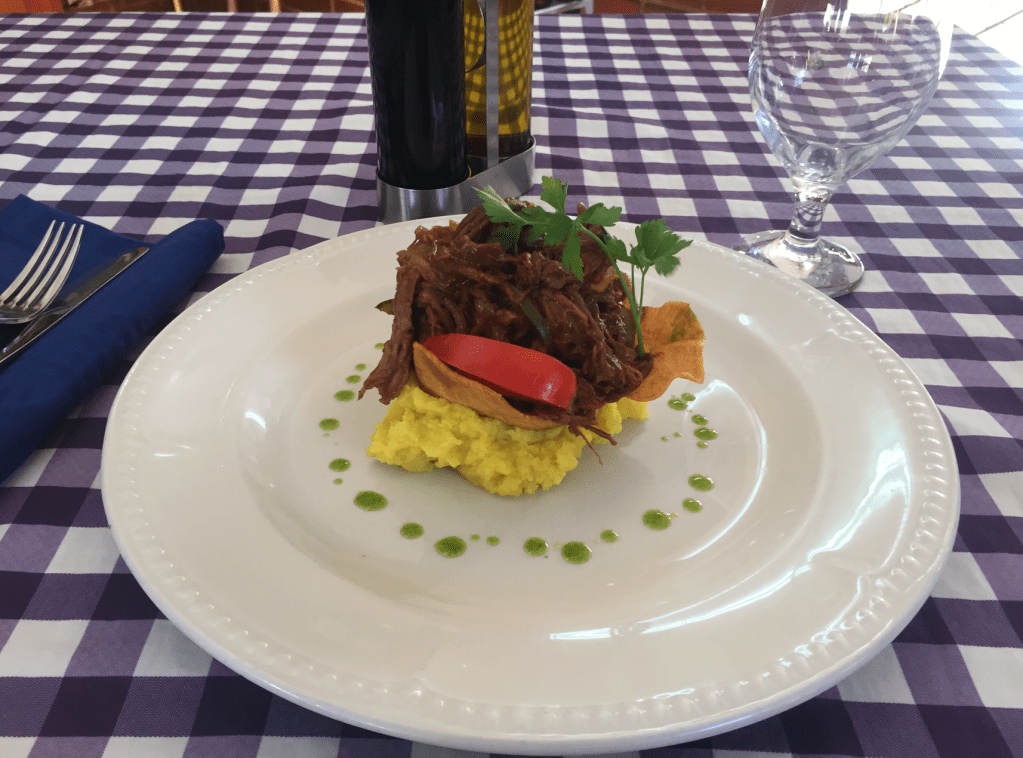
beef typically cooked with onions, peppers and tomatoes.
References
Bernstein, H. (2016). Agrarian political economy and modern world capitalism: The contributions of food regime analysis. The Journal of Peasant Studies, 43(3), 611-647. doi:10.1080/03066150.2015.1101456
La Vía Campesina. (2007). Declaración de nyéléni. Nyéléni, Mali: The Forum For Agroecology.
McMichael, P. (2013). Food regimes and agrarian questions. Winnipeg: Winnipeg : Fernwood Publishing.
Pietrykowski, B. (2004). You are what you eat: The social economy of the slow food movement. Review of Social Economy, 62(3), 307-321. doi:10.1080/0034676042000253927
Tencati, A., & Zsolnai, L. (2012). Collaborative enterprise and sustainability: The case of slow food. Journal of Business Ethics, 110(3), 345-354. doi:10.1007/s10551-011-1178-1
 The Cuban Recipe for Food Sovereignty